If you’ve ever gone to search for someone to help with a stubborn knot in your shoulder or neck tension that just won’t go away, you’ve probably come across both terms: masseur and massage therapist. A lot of people use them interchangeably, and I get it. But there’s an important distinction between the two that I think everyone should understand before they book a massage session.
I’m Patrick, owner of Engles Natural Healing & Massage in Marietta, Ohio. I’ve spent years helping people feel better through the power of natural healing, therapeutic touch, and holistic care. Let me break this down in plain terms so you can make the most informed decision about who you trust with your body.
Where the Word “Masseur” Comes From
The words masseur / masseuse are French in origin and literally translates to “a man or woman who gives massages.” They entered the English language well over a century ago and for a long time the standard way to refer to anyone who performed massage work.
You’ll still hear it in casual conversation, in movies, and in everyday language. And honestly, there’s nothing offensive about the word itself. But in the professional world of bodywork and therapeutic healing, the term has become outdated, and here’s why that matters for you as a client.
Unlike “licensed massage therapist,” the titles “masseur” or “masseuse” carries zero legal or professional weight. There are no educational requirements attached to it, no licensing standards, and no regulatory body overseeing anyone who uses it. That lack of accountability is a very real issue for many seeking help or care.
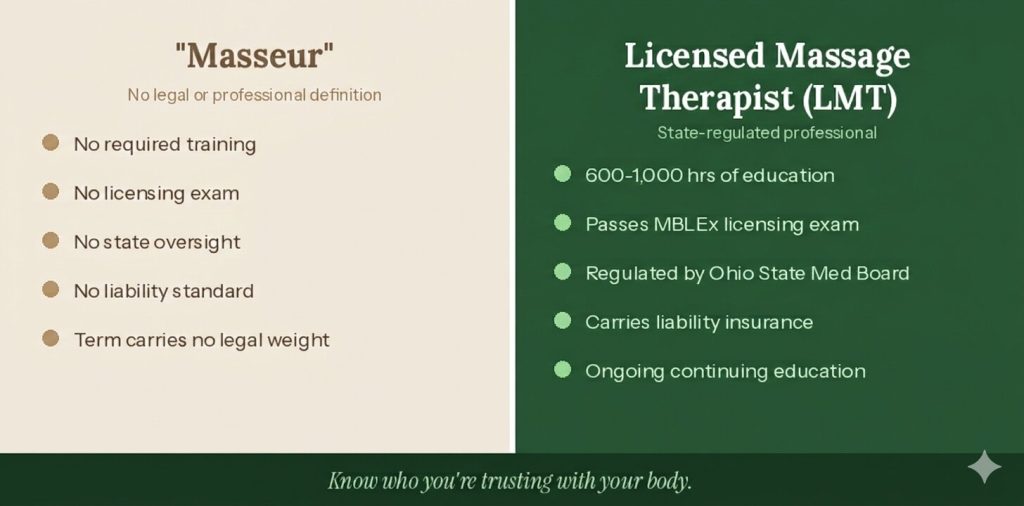
The core differences between the informal title masseur / masseuse and a state-licensed massage therapist.
What Makes Someone a Licensed Massage Therapist?
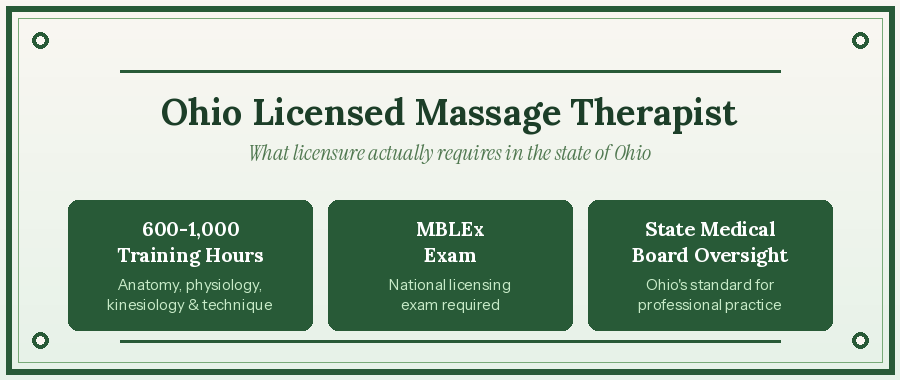
A licensed massage therapist (LMT) is not someone who learned a few techniques online and decided to start working on people. In Ohio, becoming a licensed massage therapist requires completing a state-approved educational program that typically involves between 600 and 1,000 hours of hands-on training and classroom study. That curriculum covers anatomy, physiology, kinesiology, pathology, ethics, and a wide range of massage modalities.
After completing that training, therapists must pass the MBLEx (Massage and Bodywork Licensing Examination), which is administered by the Federation of State Massage Therapy Boards. Passing this exam is required before a therapist can legally practice in Ohio. They must also maintain continuing education credits to keep their license active and current.
In Ohio specifically, massage therapy licensure is overseen by the State Medical Board of Ohio. That means every licensed therapist in the state has been vetted, tested, and is held to an ongoing professional standard.
Ohio’s three core requirements for licensed massage therapists.
💡Pro tip: You can verify any Ohio massage therapist’s license directly through the Ohio eLicense system. It’s free, takes about 30 seconds, and gives you complete peace of mind before your first appointment.
Why the Distinction Actually Matters
Here’s the heart of it. When you work with a licensed massage therapist, you’re working with someone the state has evaluated and continues to hold accountable. When you work with someone who only identifies as a “masseur”, you simply don’t have that assurance.
This matters especially when you’re dealing with something serious. If you’re seeking headache and migraine relief, recovering from a repetitive strain injury like carpal tunnel, or looking for support during pregnancy, the expertise behind the hands matters a great deal. In those situations, the wrong pressure, the wrong technique, or working on a contraindicated area can cause real harm.
According to the American Massage Therapy Association, massage therapy provides documented benefits for pain management, stress reduction, improved circulation, and more. But those benefits are only achieved when the work is done by a properly trained professional who understands how to adapt to individual health circumstances.
Massage therapy is healthcare. And like any healthcare, it deserves a provider who has earned their credentials.
Why Specialized Training Matters for Each Service I Offer
Every service at Engles Natural Healing requires specific clinical training beyond general massage certification.
Let me give you a concrete sense of why all of this training matters in the context of the services I offer here in Marietta.
Prenatal Massage
When I perform a prenatal massage, I know exactly which positions are safe at each stage of pregnancy, which pressure points must be avoided entirely, and how to provide specialized relief during pregnancy. Getting that wrong is not just uncomfortable; it can be genuinely dangerous. This is a case where specialized training is not a nice-to-have. It is a non-negotiable.
Lymphatic Drainage Massage
Our lymphatic drainage massage works directly with the body’s immune and fluid systems. The technique requires precise, deliberate pressure applied in specific directions. Working against that flow, or applying the wrong amount of pressure, can interfere with the lymphatic system rather than support it.
Deep Tissue & Cupping Therapy
Deep tissue massage is often misunderstood as simply “harder pressure.” In reality, it involves specific techniques designed to reach the deeper layers of muscle and connective tissue safely. Similarly, cupping therapy uses suction to increase circulation and release tension, but the placement and duration requires training and ongoing assessment of how the client’s skin and tissue are responding.
Reflexology & Muscle Scraping
Reflexology is a modality rooted in the idea that specific points on the feet, hands, and ears correspond to organs and systems throughout the body. It requires detailed study of those reflex zones. Muscle scraping, also known as instrument-assisted soft tissue mobilization, breaks up fascial adhesions and scar tissue. Both require precision that only comes from training.
Every one of these services requires knowledge that goes well beyond knowing how to apply pressure to sore muscles. That’s what good education and licensure gives you, and it’s what I bring to every single session at Engles Natural Healing & Massage.
How to Vet Any Massage Therapist You’re Considering
Whether you’re booking with me or someone else, here are the questions worth asking before you get on the table:
- Are you a licensed massage therapist? Ask directly. A legitimate LMT will answer without hesitation and can provide their license number. In Ohio, you can verify it at elicense.ohio.gov.
- What specific training do you have for this service? General massage certification does not automatically qualify someone for prenatal work, lymphatic therapy, or other specialized modalities. Ask specifically.
- Do you carry liability insurance? Licensed therapists in Ohio are required to maintain this. It protects you as a client and reflects a baseline of professionalism.
- Do they have client reviews you can read? Real testimonials from real people tell you what to expect. My clients have left over 120 five-star reviews, and I’m proud of every one of them.
I Still Won’t Correct You Mid-Appointment
Look, if you walk into my studio and call me a masseur, I’m not going to stop the session to correct you. Most people who use the word aren’t trying to undermine anyone’s credentials. They just grew up with it, and language changes slowly.
But I do think it’s worth understanding the difference, especially as you take more ownership of your health and wellbeing. When you understand what a licensed massage therapist actually brings to the table, you can make more informed choices about who you trust with your body. And you deserve to know that the person working on your neck, your muscles, and your nervous system has done more than read a few articles online.
If you’d like to learn more about the full range of services we offer, check out our About page or browse our service areas to see if we cover your part of the Mid-Ohio Valley.
You can also explore some of our other blog posts for more context on specific therapies, like our deep dive into what reflexology actually is or the real benefits of our Deluxe Foot Package.
